The true life of artisans-restorers and ancient restoration techniques: a heritage to be maintained and re-evaluated.
The number 100 of the magazine Kermes, relaunched by the new publisher Lexis srl, publishes, among others, this article of mine on the artisans. The article is the result of the precious will of the publisher in giving voice to this very important category.
I still have in mind a poem on the the subsidiary ofrom the primary school, showing a drawing of the dirty hands of a craftsma,n who had only those, to offer to the Lord at his death. It struck me forever, remaining a reference that still has its meaning, whereby today, more and more often, the artisans restorers appear in “white coat” using sophisticated new technologies …”4.0 artisans”.
The love for art and beauty led me to the world of restoration where I met the artisans I work with today. Mine is an experience in the field, in direct contact with the category, which represent a large part of the national manufacturing tradition.
We have worked on marvelous goods, I have met men and women full of passion, dedication and culture, who were unfortunally still struggling to get to the end of the month. I met very good restorers, as an example an exceptional gilder who was left without work because not well inserted politically.
I am vaccinated, I have learned how the world goes, but I think each and every single enthusiast creates a conscious people, so I will do my part as much as I can.
In our country, the artisan in restoration, is an historically important figure that still needs to be valued. It is a figure that makes us, even today, known throughout the world, for the ability to give new life to the great artists and architects of the past. A figure that is required by the great magnates all over the world for its ability to work the natural materials with which to reproduce the great works of the past.

Who is the artisan of restoration?
Here is the first big rock, indeed a real dam in the sector.
Restorer, artisan of restoration, craftsman. What are the differences? How to evaluate?
The theme opens the door to a more political debate, rather than a technical one, that, which I am aware of, I leave to other offices. I can only testify what happens in reality, in the daily life of the taxes to be paid, of the clients who do not pay or pay in the long term, the difficulty of being understood by the architects, the difficulty of taking a boy who wants to learn because “it costs you too much “, Fund construction contributions etc. (even if the apprenticeship contract has been re-introduced that allows hiring a boy aged 15 to 25 years, but aimed at obtaining a diploma (Legislative Decree 81/2015).
How many excellent artisans have I met, who had to close shop because they did not find anyone to pass on their knowledge to, Certainly not because “young people no longer want to work”. They themselves, having learned the trade at the age of 15 “a bottega” and to the sound of slaps, have become the best. We are responsible for this loss of culture that we can never recover. The artisans suffer, all, without distinction, and will never tell you about it because they are proud, and because they love their work more than their lives, they would never change it.
In Italy, in particular, we have the opportunity to put our hands on the most important architectural artifacts and assets in the world, therefore to perfect the processing and use of materials, as in any other country in the world. I saw recovering recipes and work during the restoration. The true artisan restorer “enters into symbiosis” with the work on which he intervenes and immerses himself in a profound historical-analytical and executive artistic contact, not only with the artefact, but with who built it in the past. During the analysis of the work and its history, can detect and reconstruct and then relive the various steps performed and the materials used in the execution phase, recognising the work and enhancing it with the restoration to bring it back to its former glory. And it is not just a matter of technique, it is also a question of soul.
For some, in absolute good faith, the artisans of the restoration are only those who have left the intense years of study at the Central Institute for Restoration in Rome or at the Opificio delle Pietre Dure in Florence or other institutional schools of excellence and as such recognized by the Ministry.
For the others, beyond the dam, the field is extended to all those who have learned in the workshop from an old artisan with years of passion, dedication and hard work.
So, perhaps, the craftsman for the restoration is not only the one that intervenes on the Battle of Anghiari (1.) and that diligently and expertly applies recipes and techniques learned by the professors during the years of study, perhaps, it is also the one who has learned from the old master of the workshop the percentages handed down and used by Michelangelo to obtain the celestial of the Sistine Chapel from the blue of lapis lazuli, and perhaps has the same right to be considered as such.
I met some young enthusiasts who, instead of doing the university, have chosen to go to the old blacksmith of the country who taught him how to beat iron to make passers-by to the railings or to the old carpenter who taught him how to return to the manner of Henry Thomas Peters. (2.) Without earning money and, sometimes, without being in good standing, at least for the first period.
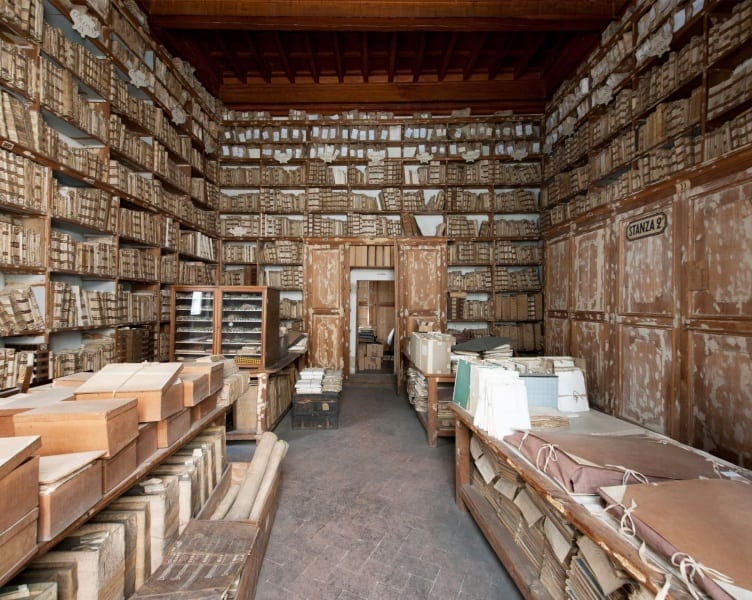
In addition to the mastery of master-masters and master craftsmen-restorers, we have an infinite number of paper material and documentation of ancient work in private libraries of historical families, in historical archives and museum vaults, a priceless and unique heritage still to be found value. We have the warehouses and libraries full as well as works, including precious documentation of books of construction sites of the great works of the past or the great workshops of painters and artisans. (See “State Archives of Venice” (3.) in which corridors are thousands of writings yet to be discovered and today still at risk of humidity).
Many master-craftsmen are still alive and fortunately many have already been able to transmit and teach to pass on their knowledge and experience to posterity.
The secrets of embalming and Egyptian petrification have been handed down to us through oral tradition. The literature writes that Segato (4.) took them to the grave but is not entirely true. They are secrets that are handed down verbally and jealously guarded and are not found in books. In a communication society, oral tradition is still very strong and important in this sector. Fortunately, the researchers’ research and computer technology are helping a lot to give strength and visibility to a whole range of information that would otherwise have remained in the dark.
In addition to the skills of men, the material used is also a predominant element in the recognition of the work quality of a restorer craftsman, and an element responsible for the change in the restoration technologies used in the last 60-70 years.
After the war, with the new materials of synthetic origin, the sector changed definitively and today we are facing an historical recovery of the original restoration “recipes”, difficult but possible.
Materials derived from petroleum are immediately ready and are much more readily available than natural materials. No special skill is needed, in their use. Using synthetic materials, a restoration or rehabilitation gives good results that are apparently good but don0t last as long as a restoration done with natural materials. We will see in the years to come, important works of art get damaged despite a precious and expensive restoration. As we see important modern works, in the process of decay because the cement is slowly crumbling.
Have you ever seen a fresco, a painting or a newly restored wooden choir and find it much less beautiful than before? Or see in the wall paintings the colors so bright and dishes that it was impossible to have thought them so in the 1300 or 1500 and above all impossible to get them so with egg yolk or cinnabar, as it was in the past. Even those who are not employed in the trade can recognize it.
This effect is given by polymers, round-shaped macromolecules that do not refract light, present in synthetic materials. I am not an expert restorer, but I have worked side by side with important restorers who do not use natural materials because they are “difficult” and because they contravene the rule that restoration should not be definitive. Synthetic products are usedtoday for cleaning and not only, also for the preparation of colors. This custom contravenes the logic: these materials did not exist when the goods were created and built. This theme has been creating passionate discussions for years.
A simple example so to better understand: up to 5 years ago there existed a myriad of natural restoration waxes and when a craftsman restorer went to buy a wax, he was asked what and for what. Today there are only 4 or 5 more. Each has its own specific use of which very few today are still known.
The restoration sector was revolutionized internationally after the flood of Florence in 1966, when it was found impotent in the face of unimaginable quantities of silt and mud on works of art and buildings, when Dino Dini (6.) introduced, among others, the use of ammonium carbonate and bicarbonate for cleaning that then made it possible to rescue it. This technique is still in use. Perhaps it would be the time to review this use, which in the opinion of many, continues its work of absorption of oils and waxes and natural materials, well beyond the end of the work with the risk of drying the surface.

Today we look for natural materials in bio-restoration. The queen of natural materials whose use is lost and mastery is lime. Now back in vogue because “… words like” Environmental sustainability “and” Conservation of Cultural Heritage “become central themes of the economic and political agendas of the most developed countries: lime is one of the possible solutions to these problems.” Rattazzi president of the Lime Forum) (5.). Unfortunately, a large quantity of organic products have been placed on the market, which are not organic. Difficult to orientate even for those in the trade. They call them the Organic-Smarts, 90% of the lime products are not lime, we find only a low percentage in the products, not enough.
The lime makes the walls breathe and lasts over time, does not crack, an unprofitable commercial logic. Yet many masons and patrons are still disoriented, often in search of real lime without finding it. In Italy we have little more than a dozen furnaces, marvelous family-run sites, which are struggling to survive: they are also a precious treasure that we should support.
Lime is difficult, you need to have experience, it is not enough to buy a bag and spread it. There are mixing times, thicknesses, drying times, each wall is different and the processing can not be homologated. Although it has been used for thousands of years all over the globe, we have lost its mastery.
The private and non-architectural cultural heritage should be obligatorily restored with plasters and lime paints, but this is not the case. I prefer not to go into political and economic reasons for which it is not.
The artisan restorer therefore, finds himself in a meander of certainties and confusions among which today it is difficult to extricate himself. He needs help, but a serious and concrete help.
A suggestion could be a hierarchy of both intervention teams and within them and form an “Order of Artisans” divided into categories, where members were selected by a suitable committee of experienced professors, restorers and restoration artisans in order to evaluate even the artisans who have not left the great Institutes. And maybe even give the guidelines to follow, for those who want to specialize and become part of it. The Order could also become a reference for those who vary from region to region and are not defined at national level.
Today the word “craftsman” is inflated as well as the word ORGANIC or the word GREEN, but the reality is quite different. We have a lot to do, the artisans need a serious help. They are a basin of history, culture, passion and love for beauty all over the world, not only in Italy, where we know we have a very high percentage of artistic and cultural works of the entire world, but in every corner of the globe. And they are alone, very alone. They force each other when they meet and recognize each other. Because without needing to speak they know what they have to face every day. Then, theyshare some strength from each other to go on for a few more months, waiting for something to change from up there in the power rooms of polytics
The numbers for action are there.
PricewaterhouseCoopers presented the report “The value of art: an economic-financial perspective” which shows a strong competitive gap in the economic return of Italian artistic and cultural heritage compared to other countries and a lack of ability on the part of the Italian system to develop the potential of our country. The analysis was illustrated in a conference organized by PwC in which there were institutional and private representatives.
According to the report, Italy has the largest cultural heritage in the world with over 3,400 museums, about 2,100 archaeological sites and parks and 43 UNESCO sites. Despite this absolute world record, the RAC, an index that analyzes the economic return of cultural assets on UNESCO sites, shows how the United States, with half the sites compared to Italy, have a commercial return of 16 sometimes the Italian one. The return of the cultural assets of France and the United Kingdom is between 4 and 7 times the Italian one. Given the wealth of Italian cultural heritage, compared to the foreign realities examined, enormous growth potentials that have not yet been exploited emerge.
The artisans are linked to our Heritage and are part of it, we have everything to give value to our future. Because in Italy, before selling everything to the Chinese, there will not be anything else.
“Those who work with their hands are a worker. Who works with his hands and his head is a craftsman. Who works with his hands and his head and his heart is an artist “. Saint Francis.
NOTE:
1. “The Battle of Anghiari”. Copy of Rubens of Leonardo’s lost work. June 29, 1603.
2. Henry Thomas Peters. An English cabinetmaker in Genoa. Ediz. Illustrated by Antonella Rathschüler published by Il Canneto, 2014
3. State Archives of Venice. Campo dei Frari.
4. Girolamo Segato: Sospirolo, 13 June 1792 – Florence, 3 February 1836) was an Italian cartographer, naturalist and Egyptologist.
5. The Forum Calce was born in 2007 in Bologna to give clarity on the materials on the market for plasters, marmoris and lime paints and to promote their use and information.